
Introduction: The Dilemma of Choosing Between Large and Small Cat Trees
When it comes to selecting a cat tree, one of the most common dilemmas cat owners face is choosing between large cat tree and a small model. Both options have their own advantages and disadvantages, and the right choice depends not only on your cat’s habits but also on the size of your living space. A large cat tree can provide more climbing space and entertainment for your cat, while a small cat tree is space-saving and suitable for compact homes. This guide will carry out professional cat tree size comparisonin detail, helping you make an informed decision that fits your home and your cat’s needs.
1. Key Differences Between Large and Small Cat Trees
To choose the right cat tree, it’s essential to understand the core differences between large and small models. From size and structure to functionality and suitability, each aspect plays a role in determining which one is right for you.
2. Large Cat Trees: Advantages, Disadvantages, and Suitable Scenarios
Large cat trees are typically over 150cm in height, with multiple layers of platforms, hiding spots, scratching posts, and sometimes even hammocks or ladders. They are designed to meet the natural climbing and exploring instincts of cats.
Advantages of Large Cat Trees
First, they provide ample space for cats to climb, jump, and play. For active cats or multi-cat households, a large cat tree can prevent competition for space and keep each cat entertained. Second, they offer more functional areas—cats can rest on the upper platforms, scratch on the posts, and hide in the enclosed nests, meeting multiple needs at once. Third, large cat trees can serve as a focal point in your home decor, adding a unique touch if designed in a stylish way.
Disadvantages of Large Cat Trees
The biggest disadvantage is that they take up a lot of space. They are not suitable for small apartments or rooms with limited floor space, as they can make the space feel cramped. Second, they are usually heavier and more difficult to move or assemble. Third, they tend to be more expensive than small cat trees, which may be a consideration for budget-conscious owners.
Suitable Scenarios for Large Cat Trees
Large cat trees are ideal for: 1. Large living spaces, such as houses or spacious apartments. 2. Multi-cat households, where multiple cats need separate spaces to play and rest. 3. Active cats that love climbing and jumping, and need more stimulation to stay happy. 4. Owners who want a functional and decorative piece of pet furniture.
3. Small Cat Trees: Advantages, Disadvantages, and Suitable Scenarios
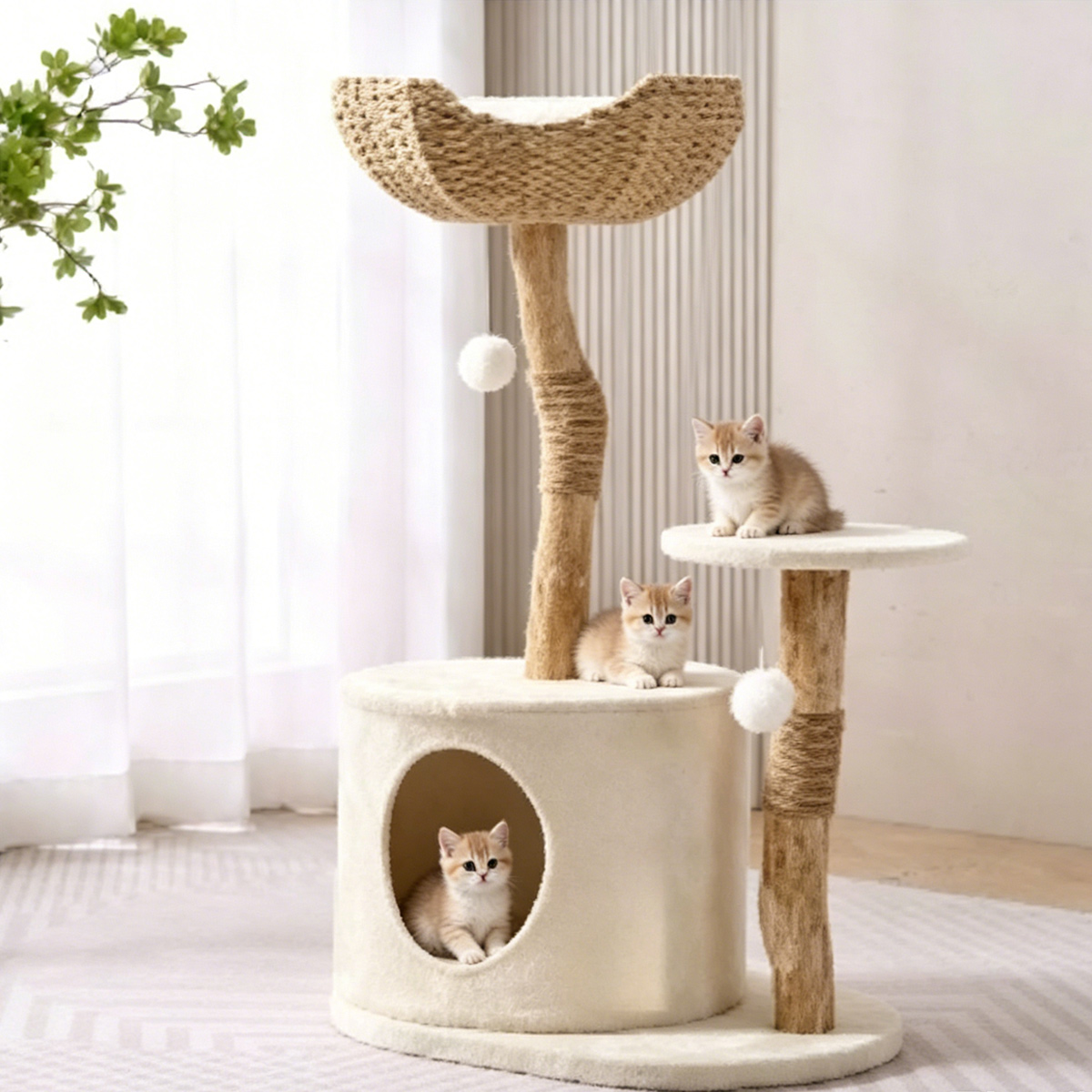
Small cat trees are usually under 120cm in height, with 1-2 platforms, a simple scratching post, and sometimes a small nest. They are compact and designed to fit into small spaces.
Advantages of Small Cat Trees
The most obvious advantage is their space-saving design. They can fit into corners, next to sofas, or even on shelves, making them perfect for small apartments or rooms. Second, they are lightweight and easy to move, assemble, and clean. Third, they are more affordable than large cat trees, making them a great choice for budget-friendly owners. Fourth, they are suitable for cats that are less active or prefer to rest rather than climb.
Disadvantages of Small Cat Trees
The main disadvantage is the limited space for cats to climb and play. For active cats or multi-cat households, a small cat tree may not be enough to meet their needs, leading to boredom or competition. Second, they have fewer functional areas, so they may not provide enough stimulation for cats that love exploring. Third, they are less stable than large cat trees if not designed properly, as their base is usually smaller.
Suitable Scenarios for Small Cat Trees
Small cat trees are ideal for: 1. Small apartments or rooms with limited floor space. 2. Single-cat households with calm, less active cats. 3. Owners who are on a budget or need a portable cat tree. 4. Owners who want to place the cat tree in a compact area, such as a bedroom or home office.
4. How to Decide: Key Factors to Consider
When choosing between a large and small cat tree, consider the following key factors to make the right decision:
① Your Living Space: Measure the available floor space where you plan to place the cat tree. If you have a small apartment, a small cat tree is a better choice. If you have ample space, a large cat tree can provide more value for your cat.
② Your Cat’s Habits: Observe your cat’s behavior. If your cat loves climbing, jumping, and exploring, a large cat tree is more suitable. If your cat prefers to rest and only climbs occasionally, a small cat tree will suffice.
③ Number of Cats: For multi-cat households, a large cat tree is recommended to avoid competition. For single-cat households, a small cat tree may be enough.
④ Budget: Consider how much you are willing to spend. Large cat trees are usually more expensive, while small ones are more budget-friendly.
Conclusion: Choose the Right Size for Your Home and Cat
There is no “one-size-fits-all” cat tree—both large and small models have their own merits. The key is to choose a cat tree that fits your living space and your cat’s habits. A large cat tree is perfect for spacious homes and active cats, while a small cat tree is ideal for compact spaces and calm cats. By considering the factors mentioned in this guide, you can select a cat tree that brings joy and comfort to your feline friend while fitting seamlessly into your home.